
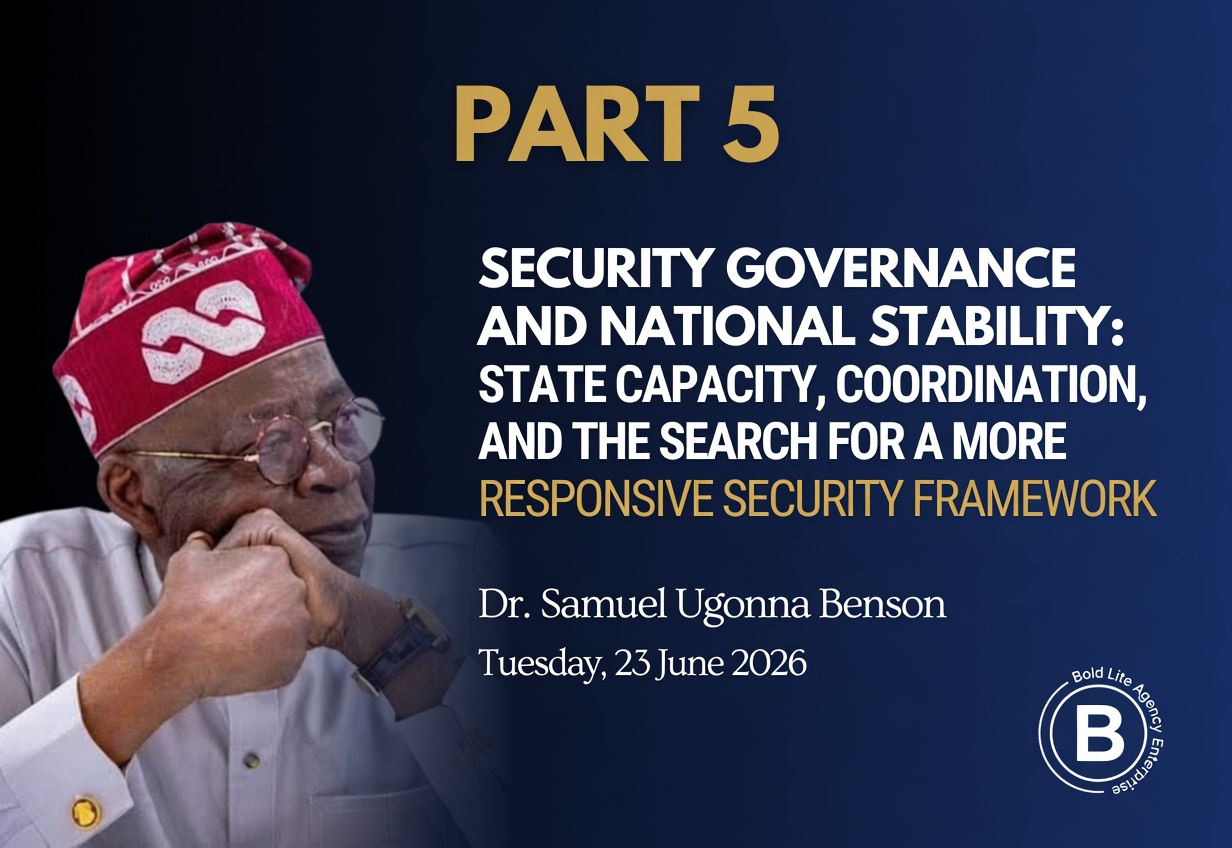
There are few things that challenge a government more than ensuring its security, and there are few things that are more obvious as verifiers of its results than how it keeps its citizens safe. The presidency of Bola Ahmed Tinubu has defined the governance of security as a military issue and an institution-coordinating, national-resiliency, intelligence-effectiveness, and public-confidence issue.
The administration was left with a much more complicated situation than it had anticipated, from insurgency and banditry to community snitching and economic security fears.
In the Governance Reform SOP lens, security governance shifted into the realm of systems’ redesign efforts in aspects of prevention, coordination, and continued stability of the state across the country.
Learn about identifying polices and policies that are considered a governance priority for security.
Such recommendations were increasingly part of the administration’s stance of shifting towards a framework that viewed national security as part of an institutional overhaul and multi-agency partnership building over specific interventions.
There was a focus on better coordination of defense institutions, intelligence services, law enforcement institutions, and discussions for constitutional reform regarding security management in government statements and policy discussions.
This directive came from supporters, and it meant welcome recognition of the need to have more adaptive governance arrangements as threats evolve.
The book is called Stakeholder Consultation: Building a Cooperative Security Architecture. Their book is entitled Stakeholder Consultation: Building a Cooperative Security Architecture.
Cooperation and consultation amongst institutions have been a feature of the security narrative of the administration.
Legislative institutions, security agencies, and state governments of various states started to feature prominently in discussions on security, along with private security comments. In addition to private security comments, conversation on security issues began to include legislative stakeholders, security agencies, state governments, and strategic policy institutions.
A remarkable feature was the discussion at a national level about what it meant to decentralise policing and the constitutional mechanisms that would enable states to become more actively involved in the delivery of security and have a say in it without losing the overarching federal oversight. Proposals in favour of state police structures were included in discussions on overhauling the institutions in Parliament.
In a positive governance context, this was an attempt to shift discussions on security from ‘after crisis response’ towards ‘structural revolution.
Design and implement security policies.
The approach adopted and executed by the administration shifted towards increasing readiness, coordination, and institutional capability.
The government made various proposals to improve training systems for security agencies and to enhance their readiness generally. The initiative to overhaul security training institutions and create structures to implement the changes got the backing of the National Economic Council.
More measures on the federalism level were security review systems to rationalize and streamline the overlapping security and paramilitary institutions and to enhance operational efficiency within institutions.
The administration also publicly led the way in large-scale security diagnostics and policy review exercises to find evidence-based recommendations to improve the national response.
These efforts voiced support for a shift from short-term, response-oriented organization management to more extensive institutional capacity development.
This session focuses on security’s performance measurement with strategic KPIs, highlighting a new asset management approach that redefines traditional viewpoints on monitoring and evaluation.
Assessment can be organized within the framework of the Security Governance KPI. The assessment can be structured as per the five Security Governance KPIs.
Security Coordination:
The collaboration of law enforcement agencies and a greater focus on a coordinated response by the government grew steadily more prominent.
Institutional Reform Progress:
There was some progress in the security sector toward a restructure based on reviews, training changes, and considerations of the architecture.
Response Capability:
There was a focus on the need to enhance readiness and fast-track decision-making within agencies arranged by the government.
Public Confidence:
The high level of expectation by the public and security’s impact on citizen confidence continued.
National Stability Indicators:
There was continued pressure on security, but the government also recognised that it faced ongoing pressure as it sought to enlarge structural changes.
Schedule a review for each assembly. Include a review in every assembly schedule.
Beyond the reasons cited above, this may be seen as a way for the administration to refocus security on a governance framework rather than as a series of one-off events.
As part of this interpretation, leadership is not just about what happens in one instance but about the ability to increase the capacity and coordination of institutions at the same time as increasing their responsiveness across time.
But perhaps the bigger historical question is whether the proposed reforms under discussion, particularly with regard to coordination, training, and constitutional changes, are actually eternalizing changes that enhance the public’s trust and national unity.
This phase is not the time to merely address symptoms of institutional inefficiencies, but it might be the one that can be considered as an effort to reinvent the security governance rather.
Preliminary Governance Assessment
Policy Vision: Strong
Institutional Coordination: Strong
Execution Direction: Positive
Citizen Security Conversion: Developing
Long-Term Stability Outlook: Dependent on Sustained Implementation
Dr. Samuel Ugonna Benson
Dr. Samuel Ugonna Benson is a Strategic Management and Leadership scholar and researcher trained at the New York Centre for Advanced Research (NYCAR). He is an author and writer with a focus on organizational strategy, operational systems, and policy development for effective institutional performance. His work centers on strengthening leadership capacity and improving governance structures across public and private institutions.