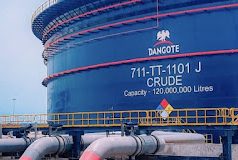

President Bola Ahmed Tinubu has approved a new investment framework aimed at unlocking up to $50 billion in fresh investment in Nigeria’s deep offshore oil and gas sector.
The Presidency said the framework replaces the previous project-by-project negotiation of incentives with a rules-based system establishing common eligibility criteria and implementation procedures for qualifying developments.
According to the Presidency, the new arrangement is intended to give investors greater certainty while protecting Nigeria’s long-term economic interests.
Related News: NRS- Nigeria Unveils New Crypto Tax Guidelines
The framework will initially support the approximately $10 billion Bonga South West project, a major Shell-led offshore development that has remained stalled amid investment and fiscal concerns. The broader framework is designed to apply to multiple qualifying deep offshore developments.
The reform takes effect through the Deep Offshore Oil and Gas Projects Incentives (Tax Remission) Order, 2026.
Under the new arrangement, qualifying investors will no longer be required to negotiate individual incentive packages for eligible developments. Instead, projects that meet prescribed conditions can access the incentives through defined rules and procedures.
Related News: Mr P’s Solo Run Gains Steam With 1M YouTube Subscribers, 3,000 Caps Sold
The approval also authorises NNPC Limited, Nigeria’s nominated counterparty under Production Sharing Contracts, to proceed with amendments to eligible PSCs required to implement the new incentive regime.
The Presidency said the decision followed Tinubu’s engagement with Shell Chief Executive Officer Wael Sawan, after which the President directed the development of measures capable of unlocking the next phase of Nigeria’s deep offshore investment pipeline.
Local Content
The government said the framework is also intended to increase Nigerian participation in offshore project execution.
Presidential Special Adviser on Oil and Gas Olu Arowolo-Verheijen said qualifying projects would maximise execution within Nigeria where commercially and technically feasible.
According to the Presidency, this could increase opportunities for Nigerian companies in engineering, fabrication, marine logistics, technical services and project management.
Related News: Spider-Man: Brand New Day Soars Past $1.67 Billion Worldwide
The government said greater offshore investment could also support skilled employment, domestic supply chains, industrial capacity and local economic value.
Why It Matters
Nigeria has faced challenges in attracting sufficient capital into capital-intensive offshore oil developments, with project costs, regulatory uncertainty, lengthy negotiations and concerns over fiscal competitiveness contributing to delays.
The government is seeking to make the country’s deepwater sector more competitive by providing investors with a more predictable incentive framework.
The Bonga South West project, estimated at about $10 billion, is expected to be among the first major developments to benefit from the new framework.
Related News: Delta Government Delegation’s Visit to Ebu Another Political Scam, Deception — AAC Governorship Candidate Eshor
However, the potential $50 billion investment figure should not be interpreted as money already committed or guaranteed. It represents the broader investment potential identified under the framework.
The framework was developed through an inter-agency process involving the Federal Ministry of Justice, Federal Ministry of Finance, Federal Ministry of Petroleum Resources, Nigeria Revenue Service, NNPC Limited, Nigerian Upstream Petroleum Regulatory Commission, Nigerian Content Development and Monitoring Board and industry stakeholders.
The immediate test for the reform will be implementation and whether the new rules help move stalled offshore projects toward final investment decisions.
If successful, the government expects the framework to support increased capital expenditure, oil production, employment and government revenues. The scale and timing of those benefits, however, will depend on how investors respond to the new regime and how quickly eligible projects progress.