



============================================================================
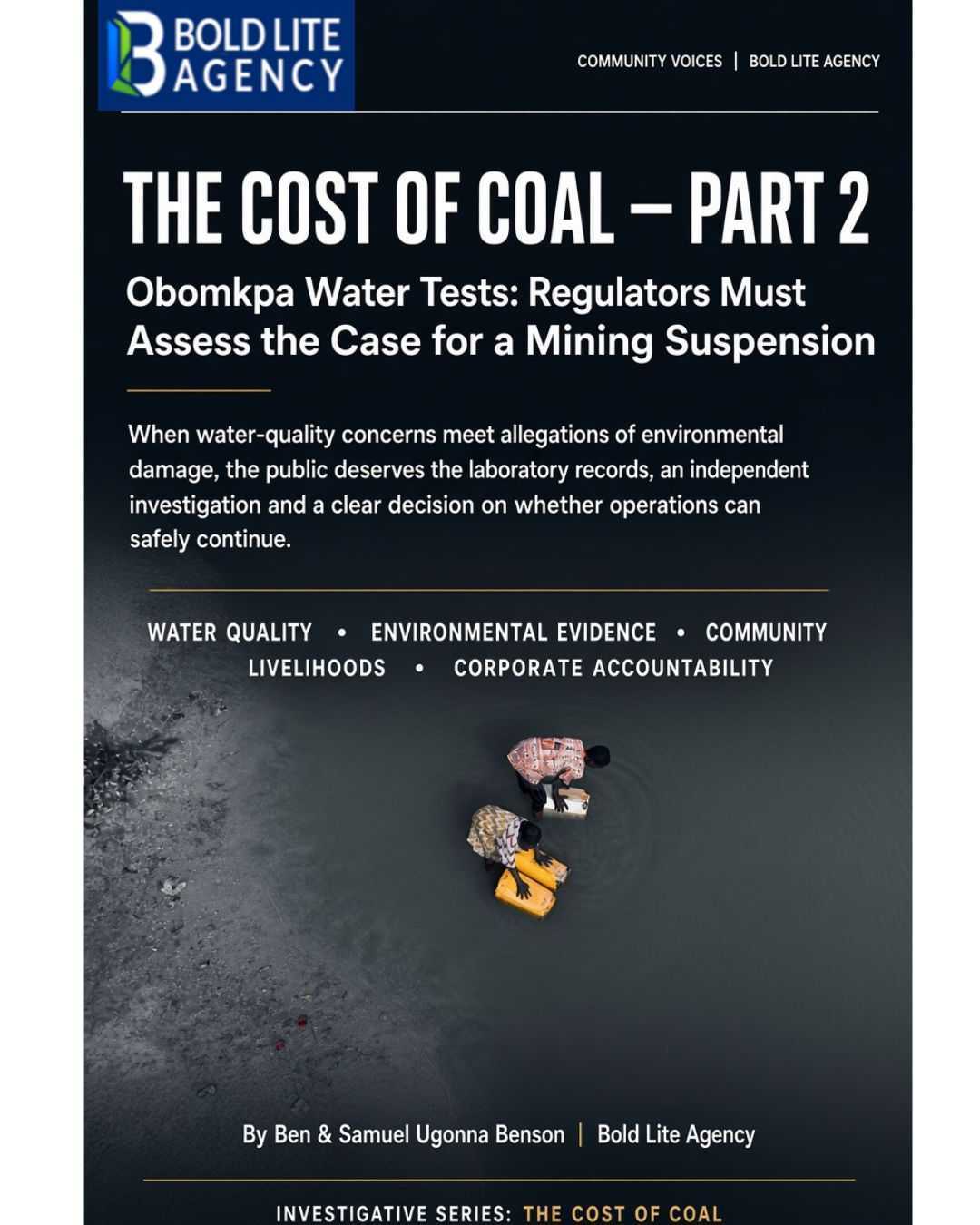
THE COST OF COAL — PART 2
Obomkpa Water Tests: Regulators Must Assess the Case for a Mining Suspension
When water-quality concerns meet allegations of environmental damage, the public deserves the laboratory records, an independent investigation and a clear decision on whether operations can safely continue.
By Ben & Samuel Ugonna Benson | Bold Lite Agency
INVESTIGATIVE SERIES: THE COST OF COAL
FOCUS: Water Quality • Environmental Evidence • Community Livelihoods • Corporate Accountability
============================================================================
The Question Beyond the Colour Of The Water
When the condition of a community’s water becomes a subject of dispute, residents should not be left to choose between competing explanations. They need reliable test results, transparent investigations and clear answers from the companies and public institutions responsible for preventing and addressing environmental harm.
In Obomkpa, Aniocha North Local Government Area of Delta State, that demand has taken on added significance. Court papers reviewed by Bold Lite Agency refer to a water-analysis report dated February 2024 and describe a second water test allegedly conducted in 2026. The same legal documents raise wider concerns about mining activity, erosion, damaged land and the condition of infrastructure associated with erosion-control works.
These references warrant serious examination. They do not, by themselves, establish that Mosra Energy Limited caused the reported water-quality problems, nor do they prove that every water source in Obomkpa is unsafe. Those conclusions require authenticated records, competent scientific assessment and evidence linking any identified contamination to its source. But the absence of a completed public explanation is not a reason to dismiss the concerns. It is a reason to obtain the evidence, investigate the competing accounts and require the responsible authorities to explain what they have done.
What The Court Papers Say About The 2024 Water Test
The statement of claim reviewed by this publication refers to a report identified as QCU/0002/24, attributed to the Quality Control and Sanitation Department or State Laboratory associated with the Delta State Ministry of Water Resources Development. According to the pleading, a stream sample was collected in Obomkpa on 26 February 2024 and analyzed on 27 February 2024. The court document reproduces the following results and comparison values.
These figures have not been independently authenticated against the original signed laboratory report for this publication. The colour unit reproduced as “Hz” requires clarification from the issuing laboratory. The applicable standards, test methods, sampling details and interpretation of the microbiological findings must also be confirmed. If the figures are accurate and the comparison values are appropriate to the intended use of the water, several of the reported results would warrant prompt technical investigation. High turbidity, abnormal colour and the reported detection of microorganisms can raise questions about water treatment and suitability for particular uses. The reported iron and copper values also require interpretation against the applicable water-quality standards. The table is therefore a serious lead—not a substitute for the laboratory record.
Bold Lite Agency has not established from the court papers alone whether the report was issued in the form described, whether its methods and quality controls were adequate, or whether the sample represented other water sources in the community. Those are questions the original report and the issuing laboratory must help resolve.
What The Numbers Can—And Cannot—Prove
Water quality is not a matter of appearance alone. Water that looks clear is not necessarily safe, and discolouration does not identify the substance responsible or prove who caused it. A laboratory result can describe the condition of a particular sample at a particular place and time. Establishing the source of a problem requires additional evidence: the precise sampling location, the surrounding land uses, the movement of surface water, possible natural or human sources of sediment and contaminants, and the relationship between those factors and any nearby operations.
That distinction matters in Obomkpa because the allegations concern both water and changes to the surrounding landscape. Mining-related runoff, erosion, disturbed soil and other environmental processes may need to be investigated, but the responsible explanation cannot be selected in advance of the evidence.
The microbiological results reproduced in the pleading also deserve careful treatment. If confirmed, the reported detections would warrant assessment by qualified water-quality and public-health professionals. They would not, without further evidence, establish that particular residents became ill because they used the sampled water. The public needs the facts, not an exaggerated conclusion. The laboratory must establish what was found; an independent technical investigation must assess possible sources; and the competent authorities must explain what protective measures are required.
The Missing 2026 Report
The court papers also refer to a second water test allegedly conducted in 2026, described in the pleading as showing heavy-metal pollution. The report itself was not reproduced in the material reviewed for this article. That gap is significant. Without the original report, its sampling date and location, the list of tested substances, the measured concentrations and the relevant comparison standards, the claim cannot responsibly be presented as an independently verified finding.
The 2026 document should be obtained from its issuing laboratory, the party relying on it or the relevant public authority. Its authenticity and technical basis should be checked, and any disputed results should be assessed independently. If the report confirms a serious water-quality risk, the appropriate authorities should identify the affected sources, communicate the risk clearly to residents and take measures proportionate to the findings. If it does not support the allegation as presented, that conclusion should also be made public. The same principle applies to the 2024 report. Publishing complete, authenticated evidence would help the community, regulators and company move beyond competing claims.
Water, Land and The NEWMAP Questions
The dispute described in the court papers extends beyond water quality. The plaintiffs allege that mining activity has contributed to environmental damage, including erosion and problems affecting areas associated with the Nigeria Erosion and Watershed Management Project, commonly known as NEWMAP.
These are allegations in legal documents, not findings of a court established by the material reviewed for this report. Determining whether mining activity damaged particular works requires a clear picture of where those works were located, their condition before and after the alleged damage, the timing of relevant activities and the physical mechanisms that may have caused any deterioration. The necessary records should include the project boundaries, engineering designs, completion and handover documents, inspection reports and any available baseline photographs. These should be compared with reliable maps of the mining or exploration area, drainage routes, roads, gullies and nearby water sources.
An independent site assessment should then establish whether the locations overlap, whether damage occurred and, where damage is confirmed, what the evidence says about its cause.
This is not a technicality. If public funds were spent on erosion-control works that later failed, the public has a legitimate interest in knowing why. If mining activity contributed to that failure, the responsible parties should be required to address it in accordance with the law. If other causes were responsible, the findings should say so. Neither a company’s denial nor a community’s allegation can replace a properly documented technical assessment.
The People Behind the Evidence
A water-quality dispute is also a question about daily life. Residents need to know whether the water they collect is suitable for drinking, cooking, washing, farming or other uses. Families need practical advice when a source is under investigation, not uncertainty about which account to believe. Children require particular attention. Where water concerns affect homes or schools, the consequences may extend to hygiene, attendance, learning conditions and household costs. These are important questions for investigators to examine, but Bold Lite Agency has not independently established the extent of any such effects in Obomkpa.
The United Nations Guiding Principles on Business and Human Rights provide a relevant framework for examining business responsibilities, human-rights risks and access to remedy. UNICEF’s water, sanitation and hygiene guidance also emphasises safe water and protective conditions for children. These frameworks help define the questions that responsible companies and public authorities should address; they do not establish that a particular company caused harm in this case.
The practical questions are local and measurable. Which water sources do households use? Which schools or public facilities rely on them? Are alternative sources available and affordable? Have residents received credible test results and clear guidance? Have any confirmed risks been assessed by public-health professionals? Those questions should be answered through community interviews, documented observations, school and health-facility information where lawfully available, and reliable water testing. The experiences of residents deserve to be heard, while personal accounts of illness or hardship must not be converted into medical or causal conclusions without supporting evidence.
The Accountability Test: Can Operations Continue Without an Independent Assessment?
The central question is not whether the public should presume guilt. It is whether the reported water-quality concerns and allegations of environmental damage have been investigated thoroughly enough for residents and regulators to understand the risks and determine what action is necessary.
Nigeria’s Minerals and Mining Act, 2007 provides a specific legal basis for addressing credible dangers arising from mining operations. Section 146(4) empowers the Mines Inspectorate Department to issue a written order suspending prospecting or mining operations in an area until arrangements considered necessary to prevent danger to life or property, or to secure compliance with the Act, have been made. Under section 146(6), such an order lapses after 14 days unless confirmed by the Department.
The Act also addresses environmental pollution and water protection. Section 111 requires mineral-title holders to take necessary steps to prevent pollution resulting from mining operations, while section 123 prohibits pollution of water or watercourses in the course of mining or mineral exploration. These provisions make an evidence-led regulatory assessment essential; they do not, by themselves, establish that any particular allegation against Mosra Energy Limited has been proved.
Bold Lite Agency therefore calls on the Mines Inspectorate Department and the Mines Environmental Compliance Department to review the concerns documented in the court papers, obtain the original laboratory reports and conduct or commission an independent assessment of the relevant locations. The investigation should examine water quality, drainage, erosion, the condition of nearby infrastructure and the company’s applicable environmental obligations.
The authorities should also make a reasoned determination of whether the evidence meets the statutory threshold for a temporary suspension or other protective measures. If credible evidence indicates a danger to life or property, or a need to secure compliance with the Act, the competent authority should consider the powers available under section 146 and any other applicable law. Any order should be issued by the legally empowered authority, on the evidence and in accordance with the relevant procedure.
This is a demand for a defensible regulatory decision, not a declaration that wrongdoing has already been proved. Continued operations should not be treated as proof that no environmental risk exists, just as allegations alone should not be treated as proof of liability. The public deserves the evidence, the regulator’s reasoning and a clear account of the action required to protect people and the environment.
Questions Mosra Energy Limited and The Authorities Must Answer
Mosra Energy Limited should be given a clear opportunity to address the concerns raised in the court papers and to provide relevant evidence. The company’s response should be assessed alongside independent findings, not accepted or dismissed merely because it comes from an interested party.
The questions requiring answers include:
- Water monitoring: Has the company reviewed the report identified as QCU/0002/24? Does it hold water-quality results for the area from 2024 onwards? If so, will it publish the relevant reports, sampling locations, dates, tested parameters and laboratory details?
- The alleged 2026 test: Has the company obtained or reviewed the report described in the court papers? Does it dispute the results, the sampling process or their interpretation? What technical evidence supports its position?
- Operational approvals: What mineral title, environmental approvals and operating conditions apply to the activities in the area? What monitoring, rehabilitation and environmental-protection obligations are attached to them?
- NEWMAP and erosion: Has the company or a competent authority assessed the condition of the erosion-control works and their relationship to mining or exploration activity? Are there maps, inspection reports or independent findings that establish the relevant locations and causes of any damage?
- Community engagement: What consultation, community-development agreements or memoranda were concluded with affected communities, and what records establish the process followed and the obligations undertaken?
- Protective action: What procedures are in place to prevent or respond to runoff, sediment movement, water contamination and erosion? Have any corrective measures, remediation works or alternative water arrangements been provided in response to identified risks?
The relevant regulators must answer a parallel set of questions. Have they inspected the affected locations? Have they obtained and reviewed the original laboratory reports? Have they issued any directives or required corrective action? What independent evidence supports their conclusions, and will they publish a reasoned account of the action taken?
These questions should be answered with records wherever possible. General assurances that operations are compliant, or general allegations that they are not, are insufficient substitutes for evidence.
What Bold Lite Agency Is Demanding
Bold Lite Agency’s position is straightforward: the concerns should be resolved through independent evidence, transparent oversight and action proportionate to the findings.
The publication calls for:
- Disclosure of the original laboratory records cited in the court papers, including clarification of the reported colour unit and confirmation of the applicable comparison standards.
- Independent water testing at mapped locations, with clear procedures and public reporting of the results.
- A documented environmental and engineering assessment of the reported erosion, land damage and NEWMAP-related concerns.
- A transparent regulatory review of the relevant mining approvals, monitoring obligations, inspections and corrective actions.
- An assessment of whether temporary restrictions or suspension are necessary to protect people and the environment while credible risks are investigated.
- Clear public communication and appropriate protective measures if testing identifies unsafe water sources or other immediate risks.
- Accountability and remediation where evidence establishes responsibility, with a clear explanation of the measures required and the body responsible for enforcing them.
If the evidence establishes serious violations, the response should not stop at another report. The competent authorities should take the enforcement action permitted by law, which may include suspension or other restrictions where justified. If the evidence does not support a particular allegation, the findings should make that clear as well.
The Right Of Reply—And The Public’s Right To Answers
Mosra Energy Limited is entitled to respond to the allegations, challenge inaccurate information and provide documents that may alter the assessment of the evidence. The relevant government agencies and laboratories should likewise have the opportunity to explain their records and decisions.
Bold Lite Agency will report substantive responses fairly and distinguish between claims, documented findings and unresolved questions. Any response received should be assessed on its merits and reflected in the reporting process. A lack of response, if that is ultimately the case, would not itself prove wrongdoing. The public interest requires something more durable than a contest of statements. It requires the original laboratory reports, a credible independent assessment, a clear explanation of the environmental evidence and a regulatory decision that can withstand scrutiny.
The people of Obomkpa should not have to rely on speculation about the water they use or the land on which their livelihoods depend. They deserve to know what the tests show, what caused any confirmed damage, what risks remain and what action the law requires.
Editorial concern: “The question now is whether the complete scientific and environmental record will be made available—and whether the authorities will act on what that evidence establishes.”
This report examines allegations and evidence referenced in legal documents. The figures attributed to report QCU/0002/24 have not been independently authenticated against the original laboratory report for this publication. Allegations against Mosra Energy Limited and other parties are not presented as judicial findings. The company and relevant authorities should be given a fair opportunity to respond.