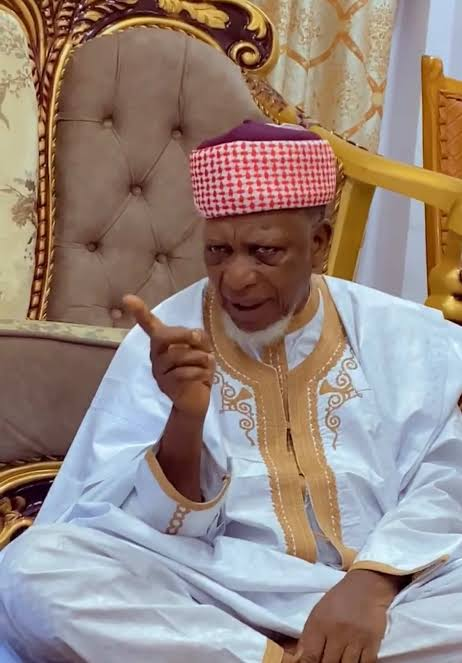
A religious debate is currently being heated up for the second time in Nigeria after a Muslim cleric, Sheikh Sani Yahaya Jingir was quoted as saying that the Muslim-Muslim presidential ticket has shown that Muslims are more in number in the country than Christians.
The esteemed Islamic scholar, Jingir, who is also the national chairman of the Council of Ulama of Jama’atu Izalatil Bid’ah Wa’ikamatis Sunnah (JIBWIS), has clearly been standing with President Bola Ahmed Tinubu and vice president Kashim Shettima in their Muslim-Muslim combination.
The latest comments, Sahara Reporters reports, have started fresh queries regarding Nigeria’s increasingly polarised political landscape, before the next presidential election in 2027, concerning the influence of religious identities.
Related News: Cocaine Shipment Disguised as Phone Chargers Intercepted by NDLEA
Jingir is not new to his support for the Tinubu-Shettima ticket, adding that he voted for them because of their Muslim beliefs. He again said in February 2026 that he would not be rolling out a new president, as Shettima is likely to attract the backing of influential Islamic clerics, if Tinubu is replaced.
The cleric’s latest remarks reportedly went further and suggested Muslims demonstrate their power by “showing infidels their limit” – a remark that is likely to further heighten concerns regarding the use of religious identity as a means of political mobilization.
The comments in particular are especially weighty in Nigeria where two religions, Islam and Christianity, are the dominant faiths with questions on balance in the region, ethnicity and religions having influenced presidential politics in the country.
Related News: Osun Election: Police Chief Steps Aside Amid Political Complaints
The issue also reared its head during electioneering activities which followed Harisey’s visit to Zacchaeus to visit the national party of his home state, the All Progressives Congress (APC), who themselves fielded Tinubu and Shettima for their presidential contest in 2023, thus creating the first major-party Muslim-Muslim presidential team since the dawn of democracy in 1999.
Those who supported the argument said that competence and political fitness should be the first to be considered before balancing on the religious front and others said excluding a Christian from either of the two highest offices in the regime might add to the religious mistrust.
One of the most prominent religious voices antagonistic to the arrangement has continued to be one from Jingir—who represented the “opposition.” On a previous occasion in a statement earlier in 2024, he stated that he wasn’t regretting his support of the ticket and would support a Muslim-Muslim presidential combination.
Related News: Lionel Messi’s Father Jorge Dies at 68 in Argentina
His political gambits have been broader than just on the presidential ticket. He commended the President on his bold move towards improving the electoral process by appointing Dr. (Professor) Joash Ojo Amupitan to the independent National Electoral Commission( INEC) presiding chair in February, 2026, saying that the move was a serious threat and urging a higher level of confidence in the electoral body leadership.
Jingir is thus in the wider context of the Nigerian argument on religion, representation and political power.
His detractors consider his interventions as interference in politics and religion and believe that only the political leaders and religious scholars should be allowed to do it without using language that might help to undermine religious divisions. His supporters believe that his actions are valid attempts to defend the interests of Muslims.
As political forces stalemate in wait for 2027, so too does the latest controversy.The latest controversy also arrives on tides of political alignment up to 2027. Tinubu’s political camp has consistently marketed the administration’s performance and reform policies as the foundation for re-election, with opposition parties trying to unite diverse coalition of religious, regional and political interests.
Related News: Adeleke Calls for Strong Osun Voter Turnout
This will be an uphill task for the Nigerian electoral terrain as change is set to be the yardstick of political competition more driven by religious lines. Its constitutional system promotes religious freedom and political engagement, and all elections are designed to enable citizens to elect leaders based on their candidate’s and programme’s preferences.
Jingir’s comments are likely to contribute to an already heated national debate on the role of religion as a key organising factor in the presidential politics of the country.
Political observers, religious groups and civil society will be eagerly monitoring the strength of the Muslim-Muslim ticket as the election nears 2027, as well as religious motivating in voter behaviour.
The reference to “showing infidels their limit” is reported from Jingir and not the identity of a nation position of Muslims or JIBWIS without further confirmation.