
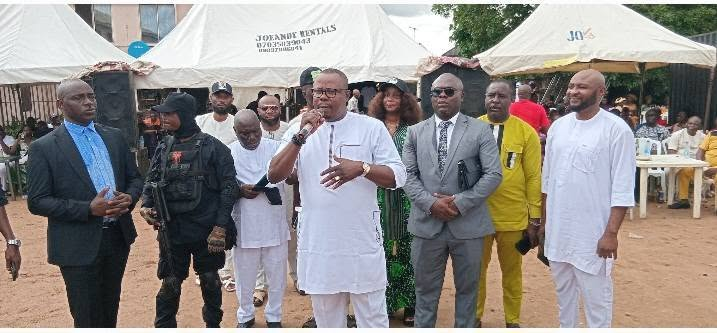
The African Action Congress governorship candidate in Delta State, Engr. Isaac Eshor, has unveiled a development agenda focused on maritime expansion, vocational training, employment creation, education, healthcare and social welfare ahead of the 2027 governorship election.
Eshor presented the proposals during the party’s consultative visit to Oshimili South Local Government Area, where he outlined his vision for addressing unemployment and improving living conditions across the state.
Central to the AAC candidate’s agenda is the development of Delta State’s maritime sector, which he said holds significant economic potential but has yet to receive sufficient investment.
Eshor proposed the establishment of vocational training centres across the state and the development of a functional dry dock, arguing that both projects could create direct and indirect employment opportunities for young people and skilled workers.
According to him, vocational education would equip residents with practical skills while supporting businesses and industries that require trained technical personnel.
“Vocational centres and a dry dock can solve the problem of unemployment. They will create multiple chains of jobs,” Eshor said.
The governorship candidate argued that Delta’s coastal location and marine resources provide an opportunity for the state to develop stronger maritime and marine-based economic activities.
He said his administration, if elected, would pursue investments designed to position the state as a major maritime hub and expand economic opportunities linked to the sector.
ALSO READ: Mary Habila ‘Mara’ Laid to Rest in Kaduna as Family Reveals Longstanding Heart Condition
Eshor also raised concerns about port infrastructure in the state, maintaining that Delta should make greater use of its geographical and economic advantages.
He further claimed that some ideas he had previously submitted to the Delta State Government were later reflected in discussions during the state’s recent Economic Summit.
The AAC candidate said his proposed development blueprint was designed around what he described as practical solutions to Delta State’s economic and governance challenges.
Beyond maritime development, Eshor placed education, healthcare and social protection among the priorities of his proposed administration.
He promised free primary and secondary education and said his government would work to improve learning facilities and expand access to quality education across the state.
The candidate also proposed a social welfare programme for elderly residents, including monthly stipends.
He further pledged financial support for persons living with disabilities as part of a broader plan aimed at reducing economic hardship and improving welfare.
On healthcare, Eshor said his administration would provide free medical services, arguing that access to quality healthcare should not be determined by a resident’s financial capacity.
The proposals form part of a wider campaign message centred on job creation, human capital development and increased government support for vulnerable groups.
Eshor said his decision to seek the governorship was driven by what he described as the need to improve governance and ensure that public resources are deployed for the benefit of Delta residents.
“I am not a politician; I am here to liberate Delta,” he said.
He also accused unnamed political interests of benefiting disproportionately from the state’s resources and pledged to challenge what he described as entrenched structures that have limited development.
The comments formed part of the AAC’s broader call for political change in Delta State ahead of the 2027 elections.
ALSO READ: Abuja–Kaduna Gridlock Traps Travellers for Days as Alleged Roadside Levies Add to Ordeal
Speaking during the consultative engagement, the Delta State Chairman of the AAC urged residents to support the party and described it as a credible opposition platform seeking to offer an alternative direction for the state.
The party chairman also identified education as a major component of the AAC’s political agenda.
He called on supporters to mobilise for the party’s candidates at different levels in the next general election, including the AAC’s presidential candidate, Omoyele Sowore.
The chairman urged party members and supporters to strengthen grassroots mobilisation as political activities gradually build towards the 2027 elections.
Supporters at the event expressed optimism about Eshor’s proposed agenda, particularly his focus on maritime development, vocational training, employment and social welfare.
They argued that increased investment in productive sectors could expand economic opportunities and improve public services.
The dry dock proposal is one of the major infrastructure commitments outlined by Eshor during the engagement.
A functional dry dock could support ship maintenance and other maritime activities, while vocational centres could provide training for people seeking technical and practical skills.
However, Eshor did not provide details at the event on the proposed cost, locations, funding structure or implementation timetable for the projects.
Similarly, the financial framework for his proposed free education, free healthcare, elderly stipends and disability support programme was not outlined in the information released from the consultative visit.
The proposals therefore remain campaign commitments subject to further policy details as the 2027 election approaches.
Eshor’s message nevertheless places employment at the centre of his political programme.
His argument is that Delta can create wider economic opportunities by investing in sectors linked to its natural location and by expanding access to vocational and technical training.
The candidate also connected economic development with social investment, presenting education, healthcare and welfare support as part of the same proposed governance framework.
ALSO READ: Xi Jinping Eyes First India Visit in Seven Years as Beijing, New Delhi Seek Diplomatic Reset
His promises reflect a campaign platform that seeks to combine infrastructure development with direct social support for different groups within the state.
The AAC’s mobilisation efforts are expected to intensify as the party works to expand its presence across Delta’s local government areas.
For Eshor, the Oshimili South engagement provided an opportunity to present his proposed policy direction directly to party members and residents.
The 2027 governorship contest is still ahead, and the implementation of Eshor’s proposals would depend on both the outcome of the election and the ability of a future administration to develop detailed policies, funding arrangements and implementation plans.
For now, the AAC candidate has placed maritime development, vocational training and social welfare at the heart of his campaign message.
His commitments include expanding employment opportunities through a proposed dry dock and vocational centres, improving access to education and healthcare, and introducing welfare support for elderly residents and persons living with disabilities.
The campaign agenda represents Eshor’s stated vision for a different approach to governance in Delta State, with the candidate maintaining that the state’s resources and economic potential should translate into broader benefits for its residents.
As preparations for the 2027 elections continue, the AAC candidate’s policy proposals are likely to form a central part of his effort to persuade voters that Delta requires a new approach to economic development, employment and public welfare.