
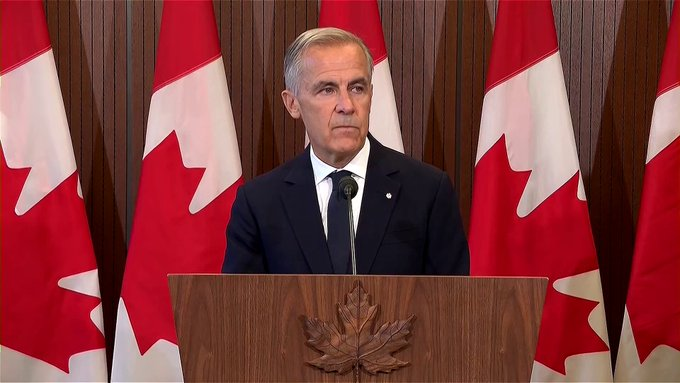
Canada will impose new tariffs on a range of imports from the United States beginning September 8, Prime Minister Mark Carney said Saturday, escalating a trade confrontation after President Donald Trump’s latest 50% tariffs on Canadian products took effect.
Carney said the Canadian measures would cover several sectors, including U.S. steel, electronics, dairy products, household appliances, agricultural equipment, pulp and paper and other goods. The move follows the collapse of trade negotiations between Ottawa and Washington.
The new Canadian tariffs are intended as a direct response to the U.S. duties that came into force at midnight on Saturday. The Trump administration’s measures impose 50% tariffs on about $20 billion worth of Canadian goods, affecting products that include wine, furniture and hockey equipment.
Carney said Canada’s response would be applied on a “dollar-for-dollar” basis, signalling that Ottawa intends to match the economic pressure created by Washington’s latest measures rather than allow the new U.S. tariffs to go unanswered.
The announcement came after last-minute negotiations between the two countries failed to produce an agreement. The breakdown has pushed the long-standing trading relationship between Canada and the United States into a new phase of confrontation.
According to Reuters, the Canadian prime minister criticised what he described as last-minute U.S. demands during the negotiations and said some of the conditions would have restricted Canada’s ability to pursue independent trade arrangements with other countries.
The dispute also involves the future of the United States-Mexico-Canada Agreement, the North American trade framework governing much of the economic relationship between the three countries. Reuters reported that Canada’s retaliatory measures will apply even to products that have protections under the agreement, further increasing uncertainty around the pact.
Related News: ₦17bn NFF Dispute Deepens as Arewa Youth Group Denies Backing Probe Call
The latest U.S. tariffs are narrower than a blanket levy on all Canadian exports. Reuters reported that the measures affect roughly 5% of Canada’s exports to the United States, although the targeted sectors include industries considered important to the Canadian economy.
Canadian officials are now preparing support measures for industries expected to bear the impact of the U.S. tariffs. Carney indicated that assistance could remain necessary for years if the trade dispute continues.
The consequences extend beyond the immediate cost of tariffs. Businesses operating across the Canada-U.S. border face the possibility of higher import costs, disrupted supply chains and weaker competitiveness as both governments introduce additional trade barriers.
The latest escalation is particularly significant because of the scale of economic integration between the two neighbours. The United States is Canada’s dominant export market, with about 75% of Canadian exports going to the U.S., according to an Associated Press report.
That dependence makes prolonged retaliation economically difficult for Canada, even as Ottawa seeks to protect domestic industries and demonstrate that it will respond to U.S. trade restrictions.
Carney has also linked the dispute to Canada’s broader effort to diversify its international trade relationships. The Canadian government has been pursuing greater economic resilience and looking beyond its traditional dependence on the U.S. market as trade tensions continue.
The latest tariff announcement follows several rounds of disagreement between Ottawa and Washington over market access, industrial policy and the terms governing bilateral trade.
One unresolved issue in the negotiations was the treatment of medium- and heavy-duty trucks. Reuters reported that U.S. resistance to extending favourable tariff terms to those vehicles became one of the sticking points in the talks, raising concerns about Canada’s automotive competitiveness.
Related News: APC Unveils 223-Member Team to Drive Tinubu’s 2027 Re-Election Bid
The failure of the negotiations has also hardened political positions inside Canada. Ontario Premier Doug Ford and opposition leader Pierre Poilievre were among Canadian political figures who supported Carney’s firm response to the U.S. tariffs.
On the U.S. side, Trade Representative Jamieson Greer said no further talks were planned following the collapse of negotiations, according to Reuters.
That position leaves the September 8 implementation date as the next major point in the dispute unless the two governments reach another agreement before then.
The immediate effect of the measures will depend on the products covered by the Canadian tariff schedule and how businesses on both sides respond. Companies that rely on cross-border supplies could face additional costs, while exporters may have to reassess prices and markets.
For Canada, the challenge is to balance retaliation against the potential economic consequences of a prolonged trade confrontation with its largest trading partner.
For the United States, the new Canadian measures create additional costs for American exporters seeking access to the Canadian market. The response could therefore extend the economic consequences of the dispute beyond the Canadian industries initially affected by Trump’s tariffs.
The escalation marks another deterioration in what has historically been one of the world’s most integrated bilateral trading relationships.
Carney’s announcement makes clear that Ottawa intends to respond to the new U.S. tariffs rather than accept them without retaliation. Unless negotiations resume and produce a settlement, Canadian and U.S. businesses will face a period of greater uncertainty as both countries adjust to the new tariff environment.
Related News: Benue Sets Aside ₦294.53m for 2026 Malaria Prevention Drive
For now, September 8 is the date set by Canada for its retaliatory measures to begin, while the U.S. 50% tariffs on selected Canadian goods are already in force.
Verification Note: The central developments in this report were cross-checked against Reuters and Associated Press reporting published on August 22, 2026. The September 8 implementation date, targeted U.S. sectors and response to Trump’s 50% tariffs are based on Prime Minister Carney’s announcement as reported by Reuters.