


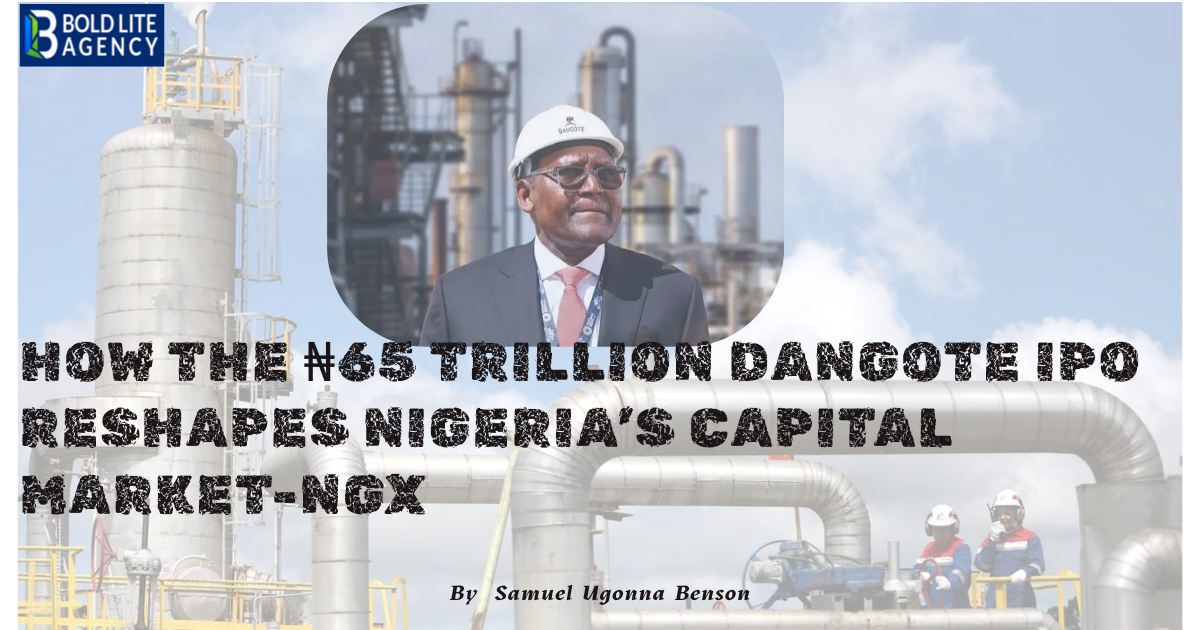

By Samuel Ugonna Benson, CEO & Lead Analyst | Bold Lite Agency
Nigeria’s Equity Market Has a New Heavyweight
Nigeria’s capital market has reached a moment when industrial scale and public ownership are beginning to converge. The Dangote Petroleum Refinery and Petrochemicals FZE IPO, which opened on September 14, offers 4.1 billion ordinary shares at ₦525 each. If fully subscribed, the transaction will raise approximately ₦2.15 trillion, making it Africa’s largest-ever initial public offering by value. The offer closes on October 13, with trading expected to commence later in November.
But the more consequential figure may not be the money being raised. At ₦525 per share, NGX puts the refinery’s implied market capitalisation at approximately ₦65.22 trillion, in addition to Dangote Cement and Dangote Sugar. The three listed or listing-related businesses would create an equity cluster valued at roughly ₦83.5 trillion on the Nigerian Exchange (NGX). That changes the conversation from one large IPO to a much broader question about the depth and concentration of Nigeria’s equity market. That’s the new heavyweight score.
₦2.15 Trillion Is Not the Same as ₦65 Trillion
The distinction matters. The ₦2.15 trillion represents the potential gross proceeds from the new shares being offered. The ₦65.22 trillion represents the implied value of the refinery based on the offer price and the company’s share structure. Treating both numbers as though they represent liquidity entering the market would exaggerate the transaction’s immediate financial impact.
The real significance is elsewhere. A company of this size entering the NGX gives domestic investors exposure to a large-scale energy and industrial asset. This gives the refinery access to a broader pool of equity capital. Reuters reports that the company intends to use the proceeds to support an expansion that would eventually lift refining capacity from 700,000 barrels per day to 1.4 million barrels per day. That creates a potential bridge between Nigeria’s capital market and its industrial investment cycle.
The Refinery’s Financial Turnaround Raises the Stakes
Investor attention is also being driven by the refinery’s operating performance. The company reported first-half 2026 revenue of approximately ₦19.47 trillion and profit after tax of ₦2.55 trillion, according to NGX. Bold Lite Agency separately reported net profit of $1.82 billion on revenue exceeding $13 billion for the same period. That represents a sharp turnaround from the previous year.
The refinery has benefited from reaching full operational capacity and from international fuel-market disruptions that have increased demand for alternative supplies. Dangote became a significant supplier of jet fuel to Europe during the recent disruption in Middle Eastern energy markets.
For investors, however, extraordinary current profitability cannot automatically be treated as a permanent baseline. Refining margins fluctuate. Crude prices move. Shipping costs change. Geopolitical disruptions eventually ease or migrate elsewhere. Simply understanding. The public market will therefore force the refinery’s performance to be examined quarter after quarter.
Retail Investors Are Becoming Part of the Liquidity Equation
The transaction’s other major feature is accessibility. Investors can subscribe for as few as 10 shares, costing ₦5,250 at the ₦525 offer price. The structure deliberately lowers the financial threshold for retail participation. It is being promoted as an opportunity for Nigerians and other eligible investors to acquire an interest in one of Africa’s largest industrial assets.
The result has been immediate pressure on the digital distribution layer. Reuters reported that the IPO overwhelmed parts of Nigeria’s fintech infrastructure as retail demand surged. Bamboo experienced a tenfold traffic increase within 30 minutes, while other investment platforms also experienced service disruptions.
That episode carries an important lesson for the capital market. Democratising investment is not simply a matter of lowering the minimum subscription. The financial infrastructure connecting millions of potential investors to the market must also be capable of handling identity verification, payment processing, order submission, customer support and cybersecurity at scale. A broader investor base demands greater operational responsibility.
Liquidity Will Move, But Not in One Direction
The IPO may also influence portfolio allocation across Nigerian financial markets. Some investors will fund subscriptions from existing cash balances. Others may rebalance portfolios by selling alternative securities or redirecting fresh savings toward the offer. Institutional investors, meanwhile, must consider how much exposure they want to one large energy asset relative to banks, consumer companies, industrial stocks and government securities.
That does not mean the IPO will automatically drain credit from banks or trigger a broad liquidity squeeze. Get that. Such an outcome would depend on the source of subscription funds, the behaviour of financial institutions, the eventual allocation of shares and what investors do after the transaction.
The more defensible conclusion is that the offer creates a new allocation decision for Nigerian investors. Capital that previously had limited exposure to large-scale refining infrastructure can now participate directly in the asset’s future performance.
A Larger Refinery Creates a Larger Capital Requirement
The IPO is also about what comes next. Dangote plans to expand the refinery’s capacity to 1.4 million barrels per day. The company expects the expansion programme to require substantial additional investment and that the IPO will strengthen its capacity to raise capital in the future.
That future financing requirement is where the capital-market experiment becomes more interesting. A successful public offering does not eliminate the need for disciplined capital allocation. It increases scrutiny.
Once public investors hold shares, management must communicate more consistently about earnings and capital expenditure. The expansion timelines, operational risks and returns on invested capital. The refinery’s industrial ambitions will increasingly be measured through the expectations of a wider shareholder base. That could deepen the relationship between Nigeria’s stock market and its real economy.
NGX Faces Its Own Infrastructure Test
The refinery may be the headline transaction, but the exchange itself is also being tested. The IPO introduces a large industrial issuer to an equity market seeking deeper participation and more significant real-sector representation. It also arrives at a time when technology is lowering the barrier between ordinary Nigerians and securities markets. That combination could have lasting consequences.
If millions of first-time or returning investors enter through the Dangote offer, the opportunity for the Nigerian Exchange extends beyond this single transaction. The challenge will be converting temporary excitement into sustained participation across a broader range of listed companies. That requires investor education, reliable digital platforms, transparent disclosures and confidence that the market can handle both rapid inflows and equally rapid exits. The refinery has brought scale. The market now has to demonstrate depth.
Bold Lite Strategic Outlook
The Dangote IPO is less a ₦65 trillion liquidity injection than a major test of how Nigeria’s capital market absorbs an industrial asset of unprecedented scale. The ₦2.15 trillion fundraising target can support expansion, while the ₦65.22 trillion implied valuation gives the NGX a new benchmark for real-sector market capitalisation. The early pressure on fintech platforms also shows that wider retail participation will require equally serious investment in digital financial infrastructure. Over the longer term, the transaction’s significance will depend on whether Nigeria can turn this exceptional IPO into deeper, more diversified and more resilient domestic capital formation.