


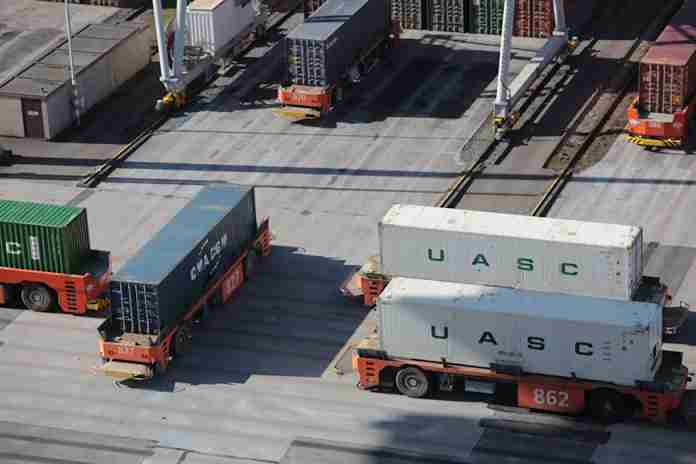

Security & Macro Desk Analysis: Data registers tracking public finance allocations confirm that Nigeria’s 2026 federal budget designates ₦5.41 trillion to defence and security alongside ₦3.56 trillion to infrastructure. While these historic allocations trace the executive administration’s top-down spending priorities, they do not establish an immediate decline in the operational security costs borne by the private sector. This strategic diagnostic filters out superficial market noise to map the precise cross-border transmission channels: parsing the structural disconnect between budgeted funds and measurable security outcomes, auditing route-specific transport logistics friction, and evaluating how the Central Bank’s newly reset 23.0% Monetary Policy Rate (MPR) interacts with actual commercial corporate lending parameters. — S.U.B.
Nigeria’s 2026 federal budget allocates ₦5.41 trillion to defence and security and ₦3.56 trillion to infrastructure, according to President Bola Ahmed Tinubu’s budget presentation. Separately, the Central Bank of Nigeria (CBN) reduced its Monetary Policy Rate (MPR) from 26.5% to 23.0% in September 2026, a 350-basis-point cut. These figures establish the scale of the government’s security and infrastructure priorities and the change in the monetary-policy benchmark; they do not establish how much has been spent specifically on protecting trade corridors or whether businesses’ security costs have declined. For logistics operators, manufacturers and energy companies, the economic test is whether public expenditure improves the reliability of roads, ports, railways, pipelines and other commercially important assets. That requires a distinction between budgeted resources, funds actually released, completed projects and measurable security outcomes. Budget Allocations Are Not Security Outcomes The 2026 budget identifies defence and security as a major spending priority, including modernization of the armed forces, intelligence-led policing, border surveillance and community-based peacebuilding. Infrastructure receives a separate allocation intended to support the country’s wider development requirements. These categories should not be combined into a single infrastructure-protection fund without a documented appropriation basis. The available official sources reviewed for this briefing do not substantiate the draft’s claimed ₦3.25 trillion Critical National Infrastructure Protection allocation, ₦845 billion drone-surveillance procurement programme or ₦465 billion rail-corridor security allocation. The distinction is material for public-finance analysis. An approved allocation authorizes expenditure; it does not prove that the money has been released, contracts awarded, equipment deployed or security improved. A credible assessment must trace specific projects through procurement, implementation and independently observable results. The Logistics Cost of Insecurity Needs Direct Measurement Security disruptions can affect delivery schedules, insurance requirements, asset protection and the cost of maintaining alternative transport arrangements. However, the scale of these effects varies by route, cargo type, threat exposure and contractual arrangements. The draft’s claimed 22.4% rise in maritime escort charges, from US$14,200 to US$17,380 per transit, could not be substantiated from the official material reviewed. Nor was a comparable source established for the claimed 2025 and 2026 private-security expenditure series. Port tariffs, private maritime-security contracts, vessel insurance premiums and route-specific transit costs are distinct measures. They cannot be combined into a single cost trend without consistent definitions, dates and geographic coverage. For an internationally credible assessment, the necessary evidence includes comparable security-contract invoices, insurance quotations, route-level incident records, transit durations and cargo volumes. Those observations would establish whether the cost of protecting commercial movements is rising and whether particular routes are becoming more expensive or less reliable. The MPR Cut and Corporate Credit Are Different Variables The CBN’s September 2026 decision lowered the MPR by 350 basis points to 23.0%. Its July decision had retained the rate at 26.5%. The reduction changes the policy benchmark, but commercial lending rates are determined by more than the MPR. Banks price loans according to funding costs, borrower risk, collateral, tenor, fees and other contractual conditions. The policy decision therefore does not, by itself, establish that financing for logistics fleets, surveillance technology or protective infrastructure has become cheaper. The draft’s asserted lending range of 28.50%–31.75% was not independently verified. The claims that 38.2% of surveyed logistics firms deferred fleet upgrades and that inventory buffers contracted from 45 days to 14 days also lack a cited survey, sample description or methodology. These figures should not appear as established sector-wide facts. The relevant financial test is the movement in actual borrowing costs for comparable business loans, alongside changes in collateral requirements, loan maturity and credit availability. That evidence would show whether the change in monetary policy is reaching the businesses expected to invest in security and transport resilience. Measuring The Return on Infrastructure Protection Security spending has economic value when it reduces disruption, protects assets and allows commercial activity to continue more reliably. For government agencies, that means linking expenditure to project delivery, equipment availability, response capability and documented changes in incidents affecting critical infrastructure. For corporate risk teams, the corresponding measures are security expenditure per unit of cargo, route-disruption frequency, insurance costs, delivery-time variability and losses attributable to security incidents. Tracking and telemetry systems should be assessed through verified coverage, system uptime and response performance rather than procurement value alone. These measures make it possible to compare the cost of prevention with the cost of disruption. They also give investors and boards a clearer basis for deciding whether to expand protective spending, change routes or revise inventory and insurance arrangements. Bold Lite Strategic Outlook Nigeria’s 2026 budget establishes security and infrastructure as major public spending priorities, while the CBN’s reduction of the MPR to 23.0% resets the monetary-policy benchmark. Neither development proves that trade corridors have become safer or that corporate protection costs have fallen. Those conclusions require evidence of expenditure execution, operational performance and actual financing terms. The decisive policy variable is the conversion of public resources into measurable improvements in infrastructure reliability. For businesses, the corresponding commercial question is whether those improvements reduce disruption, insurance exposure and the cost of moving goods. Until comparable route-level and financial data are available, boards should evaluate security investments against documented operating risks rather than unsupported sector-wide percentages. The quality of execution, not the headline allocation, will determine the economic return. Primary Sources & Regulatory Citations Registry
- Federal Government Budget Priorities: State House — 2026 Budget Speech Supports the official ₦5.41 trillion defence-and-security allocation and ₦3.56 trillion infrastructure allocation, as well as the stated security and infrastructure priorities.
- Monetary Policy Benchmark: Central Bank of Nigeria — Monetary Policy Decisions Confirms the September 2026 MPR reset to 23.0% and the July 2026 decision to retain the rate at 26.5%.
- Budget Analysis and Historical Comparison: National Institute for Legislative and Democratic Studies — 2026 Appropriation Bill Analysis Provides an independent legislative-research analysis of the budget, including the defence-and-security allocation and its comparison with previous years.