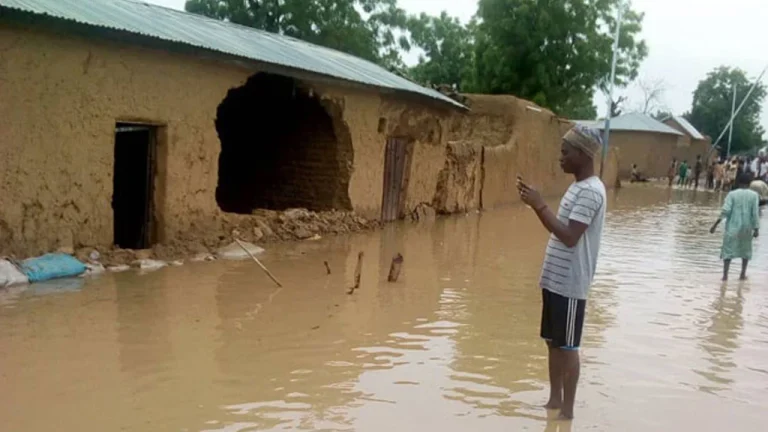
JIGAWA — A severe rainstorm has caused extensive destruction in Gandun Sarki, Malam Madori Local Government Area of Jigawa State, leaving more than 20 houses reportedly collapsed, several residents injured and families displaced from their homes.
The incident occurred during heavy rainfall on Thursday night in parts of the Hadejia Senatorial District. The downpour, which lasted for more than an hour, overwhelmed sections of the community, damaging residential buildings and affecting farmland.
The most serious incident was recorded after a residential structure gave way during the night, trapping members of a family inside. Two children, aged five and eight, were feared dead in the collapse, according to their father, Sama’ila, who spoke about the incident to journalists.
Sama’ila said the children were asleep when the building collapsed. Other members of the family survived but sustained injuries and were taken to Hadejia General Hospital for treatment.
Related News: US Court Delivers Major Visa Reprieve to Nigeria, 74 Other Nations
The incident has not only raised concerns about the safety of buildings in the affected community but has also left several families facing an immediate housing crisis. Residents said more than 20 houses were destroyed or collapsed during the rainfall, while other homes were flooded or surrounded by water.
The extent of the damage has made it difficult for some households to return home, forcing affected residents to seek alternative accommodation while waiting for assistance.
One resident, Sani Abubakar, said the flood completely destroyed his home and appealed to the Jigawa State Government to provide urgent support to displaced families. He identified shelter and relief materials among the immediate needs of residents who lost their homes and possessions.
The community has since begun efforts to establish the number of people affected and document the damage. Community leader Malam Jamilu Bulama said local representatives had been instructed to compile the names of affected residents in Gandun Sarki and surrounding areas for submission to the relevant authorities.
Related News: Benue Police Rescue 13 Kidnapped Passengers After Forest Gun Battle
That exercise could provide the first comprehensive picture of the humanitarian impact of the storm, particularly the number of displaced households and residents whose homes have become unsafe.
Bulama also pointed to existing drainage infrastructure in the area, saying structures constructed by the state government had helped limit the impact of the flood in some sections of the community.
His account is significant because flood-control infrastructure remains an important part of efforts to protect communities across Jigawa, where seasonal rainfall can rapidly overwhelm settlements situated in vulnerable areas.
Jigawa’s own planning documents show that drainage and flood-control works remain an identified infrastructure need in parts of the state. A state government town-hall report has recorded requests for drainage construction in several locations, while the 2026 Malam Madori Local Government budget includes funding for drainage and environmental infrastructure.
However, the latest incident demonstrates that infrastructure alone does not eliminate flood risk. The effectiveness of drainage systems depends on their capacity, maintenance and ability to cope with intense rainfall. Where water exceeds the capacity of drainage channels or finds its way into residential areas, the consequences can become severe within a short period.
Related News: Families of 116 Abducted Borno Residents Beg Tinubu for Urgent Rescue
Musa Muhammad, the Hadejia Zonal Public Relations Officer, confirmed that officials were aware of the incident. He said the flooding occurred in Gandun Sarki during Thursday’s heavy rainfall and that authorities were aware of reported casualties and damage to houses.
Muhammad said the zonal office was monitoring the situation.
At the time of the report, however, the Jigawa State Emergency Management Agency had not released a formal public assessment of the disaster. This means that the reported casualty figure and the full scale of the destruction remained subject to further official confirmation.
The distinction is important because the immediate accounts from residents provide valuable information about the disaster but do not necessarily constitute a final government assessment.
For families in Gandun Sarki, the consequences are already clear. Homes have been lost, belongings damaged and residents displaced, while some injured victims remain under medical care.
The destruction of farmland could create another layer of hardship for households dependent on agriculture. Flooding can damage crops, wash away stored materials and disrupt access to farms, potentially affecting household income and food security beyond the immediate aftermath of the storm.
The incident also exposes the continuing vulnerability of communities in flood-prone parts of northern Nigeria. Heavy rainfall becomes particularly dangerous where residential structures are weak, drainage networks are insufficient or communities lack effective early-warning and evacuation arrangements.
Night-time flooding presents an additional danger because residents may receive little warning before water enters homes or structures become unstable. Families asleep inside buildings have limited time to respond when intense rainfall causes sudden flooding or structural failure.
For Gandun Sarki, the immediate requirement is therefore an emergency response that goes beyond documenting the damage. Authorities need to establish the number of displaced residents, inspect damaged buildings, provide medical and humanitarian assistance and determine whether affected households can safely return home.
Temporary shelter will also be important for families whose houses have collapsed or sustained serious damage. Food, clean water and basic household supplies may become increasingly urgent if displaced residents are unable to recover their possessions.
A detailed assessment by emergency authorities would also help determine whether additional areas around Gandun Sarki have been affected but not yet formally documented.
The disaster should further strengthen calls for preventative flood management across vulnerable communities. Drainage construction must be accompanied by regular maintenance, effective waste management and restrictions against obstruction of natural and artificial waterways.
Early warnings must also reach residents in language and formats they can understand and act upon, particularly in communities where severe weather can develop quickly.
The latest flooding in Gandun Sarki is a reminder that the danger posed by extreme rainfall is measured not only in hectares of flooded farmland or damaged buildings, but in lives disrupted and families suddenly left without shelter.
For the residents affected by Thursday night’s storm, recovery will begin with determining who needs help and how quickly that assistance can reach them. For authorities, the incident provides another test of Jigawa’s capacity to translate flood preparedness and infrastructure investment into effective protection when severe weather strikes.
Until an official casualty and damage assessment is released, the reported deaths of the two children remain a grave but not yet fully independently confirmed element of the disaster. What is already evident, however, is the scale of disruption caused by the rainfall and the urgent need to support the families whose homes were destroyed.