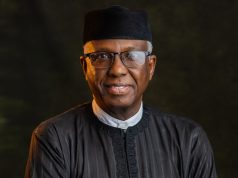

In politics, eyes tend to focus on elected representatives, ministers, governors and personalities in the news. But the longevity of political movements is often tied to people outside the limelight. Today, in Nigeria’s political unfolding, Alhaji Ibrahim Kabir Masari has become one of those executive skiers who finds importance in being connected but never in continuous presence.
The rise of Masari in the political firmament is hardly exemplary of unusual behaviour by an experienced party organiser. He was the former National Welfare Secretary of the All Progressives Congress (APC) under the leadership of the former National Chairman, Adams Oshiomhole, before his appointment to President Bola Ahmed Tinubu’s administration. Though it was not as significant as other party offices, it nonetheless put him at the heart of party administration, internal coordination and engagement with stakeholders in various parts of the country. His time in the APC gave him a vast array of internal party expertise of the strengths, dynamics and expectations of the grassroots.
It was during this build-up that his name surfaced as the APC’s “placeholder” vice-presidential candidate before the presidential election, making his relationship with Tinubu a topic of interest across the country. It was a temporary measure, but it represented a high degree of trust between the presidential nominee and a political colleague who had already demonstrated an ability to carry out orders without backlash from colleagues. The episode catapulted Masari into the national spotlight and highlighted his relevance to Tinubu’s political machine.
After the swearing-in of Tinubu, Masari was confirmed as Senior Special Assistant on Political Affairs and later promoted to Special Adviser on Political Affairs.
This promotion went beyond administrative changes. It illustrated the president’s trust in people who had institutional memory of the party and who had proven themselves in political interaction. Previous service within the APC and a role in reinforcing political coordination and support for the administration were all called out by the official statements announcing his elevation.
Understanding the importance of such an appointment is made more understandable when viewed in the context of the Nigerian government. Diverse political interests, state actors, traditional institutions, and community leaders, as well as party stakeholders, must be engaged continuously for the federal system to work in Nigeria. But only a successful election does not ensure political stability.
Only a continued dialogue between government and citizens can maintain public support. Political advisers thus act as a link between policy-making and political validation.
Samuel Huntington, a political scientist, has made it clear that viable political institutions are essential, not only for good leadership, but also in order to shape and secure competing interests.
Any governing party is dependent on its organisational abilities and the ability to meet shifting public demands. In this context, figures such as Masari support the institutional capacity available for governance. They are involved in consultation, negotiation, conflict resolution and communication between the government and political actors in different regions.
Grassroots political structures continue to be important, and so the APC’s continued dominance in several northern states is proof to that effect. The increasingly important roles for local mobilisation networks, community involvement, and party activity post-election are increasing Nigeria’s overall level of participation. Sufficient party activity during the election, community involvement and extended party presence after the election are boosting participation rates in Nigeria. The successful political parties realise that structures need to be involved during the interim between elections.
It is largely because of this understanding of local conditions and ability to gauge popular mood before it grows into political grievance that it may be necessary to have trained organisers to keep these links intact.
In this respect, Masari’s influence seems to be most significant. He brings to the presidency years of experience in party administration from his days in Katsina State and a role that will enable President Goodluck Ebelechukwu Jonathan to engage critical political stakeholders in the Northwest in a constructive dialogue with the federal government. Control and trust, inclusion and political communication are key ingredients for national cohesion and good governance in a region that continues to play a central role in national electoral calculations.
It’s not just a partisan issue; it is a lesson in political leadership. Charismatic individuals generally do not assemble sustainable political movements. They rely on a network of organisers, administrators, strategists, and negotiators to support the functioning of institutions. Structure is continuity, while leadership is direction.
Political coordinators and institution builders will continue to be pivotal in Nigeria’s democratic trajectory. Ibrahim Kabir Masari’s journey from party secretary to presidential adviser shows the enduring importance of political organisation in governance. Today, when the focus seems to be more on what is seen than what is there, his journey serves as a glaring demonstration of what the ability of political leadership is all about — how many people behind the scenes need to be able to keep all the elements of the political machine working, responsive and utilised for the benefit of the population they are meant to serve.

Dr. Samuel Ugonna Benson
Dr. Samuel Ugonna Benson is a Strategic Management and Leadership scholar and researcher trained at the New York Centre for Advanced Research (NYCAR). He is an author and writer with a focus on organizational strategy, operational systems, and policy development for effective institutional performance. His work centers on strengthening leadership capacity and improving governance structures across public and private institutions.