


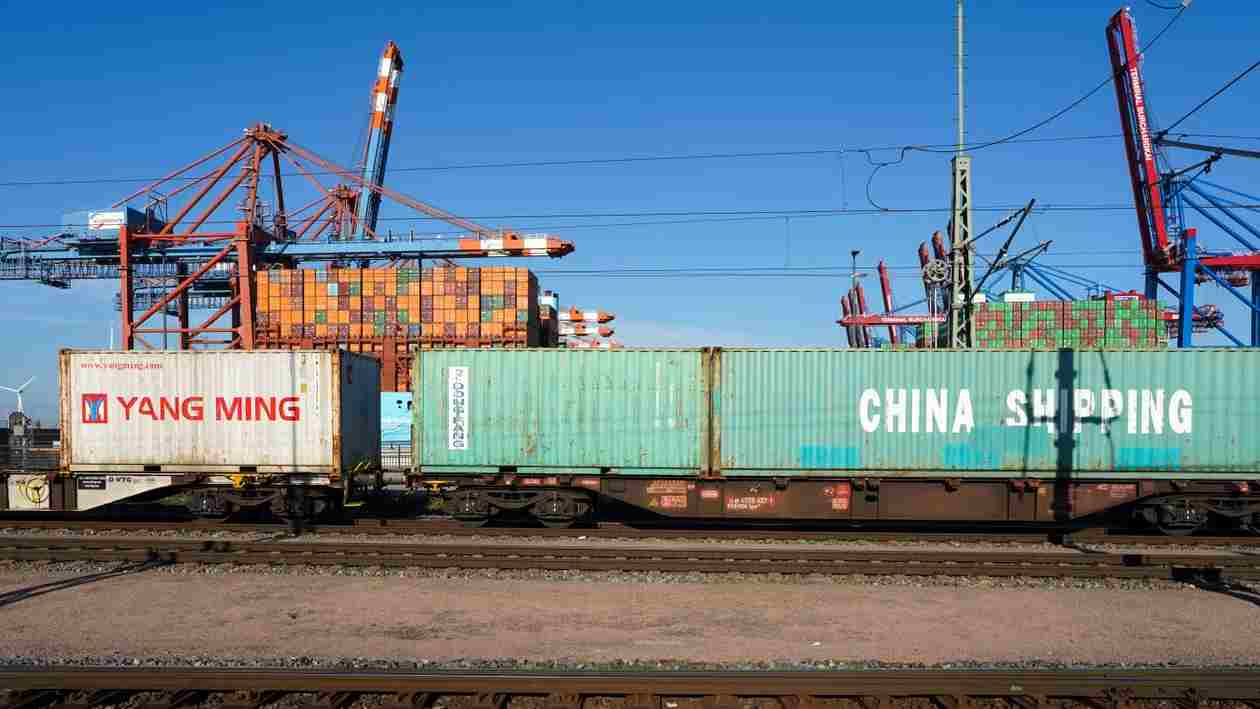

Nigeria’s trade relationship with China is expanding, but the distribution of commercial gains remains heavily tilted towards imports. National Bureau of Statistics figures show that Nigeria imported approximately ₦11.01 trillion worth of goods from China in the first half of 2026, against exports of approximately ₦1.09 trillion, producing an estimated merchandise trade deficit of ₦9.92 trillion. China accounted for 39.27% of Nigeria’s total merchandise imports during the period. Meanwhile, Chinese officials reported bilateral trade of $17.4 billion and an 81% increase in China’s purchases from Nigeria, although the two countries’ customs figures have not been reconciled. The divergence raises a more consequential policy question: whether Nigeria can convert preferential access to China’s market into sustained export earnings and domestic productive capacity.
The central trade indicator is deteriorating at the Nigerian customs level: Q2 exports to China fell 54.30% year-on-year to ₦506.57 billion, while imports increased 19.26% to ₦5.92 trillion, widening the quarterly merchandise deficit to ₦5.41 trillion.
China’s Credit Position: Weaker Bank Lending, Not A Collapse in Credit
Chinese banks recorded a net contraction of CNY100 billion in new yuan lending in October 2026, compared with an increase of CNY1.08 trillion in September. The October result was the third monthly contraction reported during the year and reflected weak demand for new borrowing from households and businesses. New yuan loans for the first ten months reached CNY11.42 trillion, down from CNY14.97 trillion in the corresponding period of 2025.
Other monetary indicators provide necessary context. China’s broad M2 money supply grew by 7.1% year-on-year in October, compared with 7.2% in September. Total social financing, a wider measure of funding that includes bank lending and other forms of financing, recorded a monthly flow of CNY 1.15 trillion. Its outstanding stock grew by 7.2% year-on-year. These indicators show that the contraction in new bank lending did not amount to a general contraction in the country’s entire credit and financing system. For Nigeria, the relevant transmission channel is the availability and terms of Chinese financing for overseas infrastructure and commercial projects. The Export-Import Bank of China and China Development Bank have historically been important lenders to African infrastructure projects. However, their financing decisions are influenced by sovereign repayment capacity, project viability, strategic priorities and risk assessments.
The Bank for International Settlements’ September 2026 analysis confirms that Chinese lending to African borrowers expanded significantly during the Belt and Road Initiative but slowed sharply after 2020. Concerns about debt sustainability, weaker project returns and financial pressures among Chinese banks contributed to the change. The BIS also notes that Chinese banks remain important creditors to several African countries. This longer-term lending pattern is relevant to Nigerian infrastructure planning, but it does not establish that the October 2026 contraction in domestic Chinese bank loans has triggered a fresh reduction in Nigerian project financing. Any such conclusion requires evidence from individual financing agreements, disbursement records, project execution and lender commitments.
The Nigerian Customs Ledger: Import Dependence Deepens
Nigeria’s own trade statistics provide the clearest measure of the domestic exposure. An analysis of the NBS Foreign Trade in Goods Statistics shows that imports from China reached approximately ₦11.01 trillion in H1 2026, compared with approximately ₦9.62 trillion in the corresponding period of 2025. The increase was ₦1.39 trillion, or 14.49%. The concentration is more significant than the nominal increase. China’s share of Nigeria’s total merchandise imports rose from 29.03% in H1 2025 to 39.27% in H1 2026. Nigeria’s overall imports, meanwhile, declined from ₦33.14 trillion to ₦28.04 trillion. China therefore strengthened its position as a principal source of imported goods even as the country’s aggregate import bill contracted.
Nigeria exported approximately ₦582.20 billion to China in Q1 and ₦506.57 billion in Q2, giving a combined H1 export value of approximately ₦1.09 trillion. Against imports of ₦11.01 trillion, the resulting merchandise trade deficit was approximately ₦9.92 trillion. These calculations use rounded published values and should be treated accordingly.
The Q2 figures reveal the severity of the imbalance. Exports to China fell from ₦1.108 trillion in Q2 2025 to ₦506.57 billion in Q2 2026, a decline of 54.30%. Imports increased from ₦4.96 trillion to ₦5.92 trillion, a rise of 19.26%. The resulting deficit widened from ₦3.85 trillion to ₦5.41 trillion, an increase of approximately 40.43%. For every naira of merchandise Nigeria exported to China during Q2, it imported approximately ₦11.68 in return.
This is the central economic exposure. China supplied 39.27% of Nigeria’s H1 merchandise imports and 41.02% in Q2. The country’s dependence is especially relevant to industrial inputs, telecommunications equipment, machinery, renewable-energy products and other manufactured goods. These imports are not economically identical: some support domestic production, while others serve consumption. The policy question is whether their acquisition expands Nigeria’s productive capacity sufficiently to generate future domestic value and export earnings.
Chinese Trade Figures: Stronger Export Growth, But A Different Customs Picture
Chinese officials reported that bilateral trade with Nigeria reached $17.4 billion in H1 2026, up 35% year-on-year. China’s reported imports from Nigeria amounted to $2.25 billion, an increase of 81%. Subtracting the reported Nigerian export value from total bilateral trade implies Chinese exports to Nigeria of approximately $15.15 billion. The figures require careful attribution. The $17.4 billion total and $2.25 billion export value were disclosed by the Director of the China Cultural Centre in Nigeria, Yang Jianxing. The $15.15 billion import figure is an arithmetic residual, not a separately published Nigerian customs figure. The Chinese-side figures also differ from the values recorded in Nigeria’s NBS statistics.
The two datasets should not be forced into a single bilateral balance through an arbitrary exchange-rate conversion. Differences in customs valuation, shipment timing, country-of-origin attribution, re-exports and final-destination recording can produce divergent results. Nigeria records imports on a cost, insurance and freight basis and exports on a free-on-board basis. No published reconciliation of the H1 figures has been identified.
The Chinese disclosure is still useful because it indicates that exports from Nigeria to China may be growing in dollar terms even while the NBS’s naira-denominated quarterly figures show a significant decline. The discrepancy makes product-level customs reconciliation and shipment-volume analysis more important, not less. Until that work is available, the NBS figures should remain the principal reference for Nigeria’s domestic import exposure, while the Chinese figures should be presented separately as the counterpart country’s reported trade data.
Zero-Tariff Access: A Market Opportunity, Not an Export Result
China’s expanded zero-tariff arrangement took effect on May 1, 2026. It extends preferential treatment to 20 African countries that maintain diplomatic relations with China and are not classified as least-developed countries. Nigeria is among the beneficiaries. The arrangement complements the zero-tariff treatment already available to 33 African least-developed countries, bringing the total number of African beneficiaries to 53. The expanded measure is scheduled to run until April 30, 2028, and applies to the specified tariff lines under the Chinese Customs Tariff Commission’s announcement.
The reported 81% increase in Nigerian exports to China during H1 cannot be attributed entirely to this policy. The six-month period includes January to April, before the arrangement commenced. Q2 also includes April, meaning that only May and June fall within the new preferential period. Aggregate quarterly figures cannot isolate the policy’s contribution.
Indeed, the NBS-based Q2 figures show that Nigeria’s exports to China declined by 54.30% year-on-year, even as overall Nigerian exports increased by 18.77%. Exports to Asia also rose by 17.55%, while China’s share of Nigeria’s exports to the region declined. The result points to a market-specific weakness rather than a general collapse in Nigerian exports to Asia. The Q2 result does not, by itself, prove that the zero-tariff policy failed. April preceded implementation, and the aggregate figures do not isolate May and June shipments. They also measure naira export values rather than physical quantities, leaving commodity prices, exchange-rate movements and product composition unresolved.
The policy’s commercial value will depend on whether Nigerian producers can meet Chinese product standards, satisfy rules of origin, secure the necessary certifications and deliver consistent volumes. Agricultural produce, processed food, aquatic products and selected mineral-based goods may offer opportunities, but preferential tariffs cannot compensate for weak logistics, unreliable supply, limited processing capacity or inadequate export financing.
Foreign-Exchange Settlement and The Limits Of The Naira–Yuan Facility
The bilateral currency-swap arrangement between the CBN and the People’s Bank of China provides a framework for facilitating trade and investment through naira and renminbi liquidity. The agreement, originally valued at CNY15 billion against ₦720 billion, was renewed in April 2024 for another three-year term. CBN’s June 2025 Financial Stability Report stated that no new transactions had taken place under the arrangement during the first half of 2025, leaving cumulative sales at CNY9.22 billion. I have not identified a newer official utilization figure as at November 15, 2026. The facility’s existence should therefore not be confused with evidence of current transaction volumes or broad adoption by Nigerian importers. A more efficient renminbi settlement channel could reduce unnecessary currency-conversion steps for eligible bilateral transactions and provide another payment option for businesses.
It would not eliminate the underlying cost of imports, automatically create additional foreign-exchange liquidity or reverse the merchandise trade deficit. Settlement infrastructure can improve transaction efficiency; it cannot substitute for export capacity.
For Nigeria’s external payments position, the more important indicators remain the value and composition of imports, export receipts, private-sector payment obligations, trade credit and the availability of settlement currencies. A bilateral deficit does not translate mechanically into an equivalent reserve loss, but sustained import demand creates recurring financing requirements that must be met through foreign-exchange earnings or other funding channels.
Bold Lite Strategic Outlook
Nigeria’s trade relationship with China is expanding, but the domestic customs ledger shows that the commercial relationship remains import-heavy. The ₦11.01 trillion H1 import bill, the ₦9.92 trillion estimated merchandise deficit and the 54.30% Q2 export decline provide stronger evidence of the challenge than the headline growth in bilateral trade alone. The zero-tariff arrangement creates a defined opportunity through April 2028. Nigeria’s priority should be to identify eligible products with demonstrable Chinese demand, expand processing capacity, improve certification and build reliable export supply chains. The objective should be to increase the volume and domestic value retained from exports, rather than treating a higher headline export-growth percentage as sufficient evidence of structural improvement.
Import policy should also distinguish between machinery and intermediate goods that support production and finished goods that compete directly with domestic manufacturers. The purpose should not be indiscriminate import restriction. It should be to improve the domestic productive return on foreign exchange spent on imported goods, while building the technical capacity, maintenance networks and supplier relationships needed to retain more value locally. Chinese credit conditions deserve continued monitoring where Nigerian infrastructure projects depend on Chinese lenders. That assessment must be based on project-level financing commitments, actual disbursements, repayment obligations and implementation milestones rather than a single monthly lending statistic from China.
The decisive measure of Nigeria–China trade performance is not the growth in bilateral turnover but the extent to which Nigeria can increase export earnings and domestic productive value relative to its import dependence. Preferential market access and alternative settlement arrangements can support that objective, but neither can deliver it without competitive production, reliable supply and a wider export base
References
Nigeria’s Foreign Trade Statistics: National Bureau of Statistics — Foreign Trade in Goods Statistics, Q1 2026 and Q2 2026.
China’s Monetary and Credit Statistics: People’s Bank of China — Official Statistics and Financial Statistics Reports. October 2026 figures were released on November 13, 2026. See also the October 2026 financial statistics report, reproducing the PBOC data.
China’s Zero-Tariff Policy: Ministry of Finance of the People’s Republic of China — Customs Tariff Commission Announcement No. 5 of 2026, April 28, 2026.
Nigeria’s Currency-Swap and Financial Stability Records: Central Bank of Nigeria — Financial Stability Report, June 2025.
Chinese Lending and African External Credit: Bank for International Settlements — International Credit to Africa, September 2026.
Nigeria–China Bilateral Trade Disclosures: Punch Newspapers — Nigeria-China Trade Rises 35% to $17.4bn in Six Months, November 12, 2026.